Resilience is the New Perfectionism — VCU Commencement Address
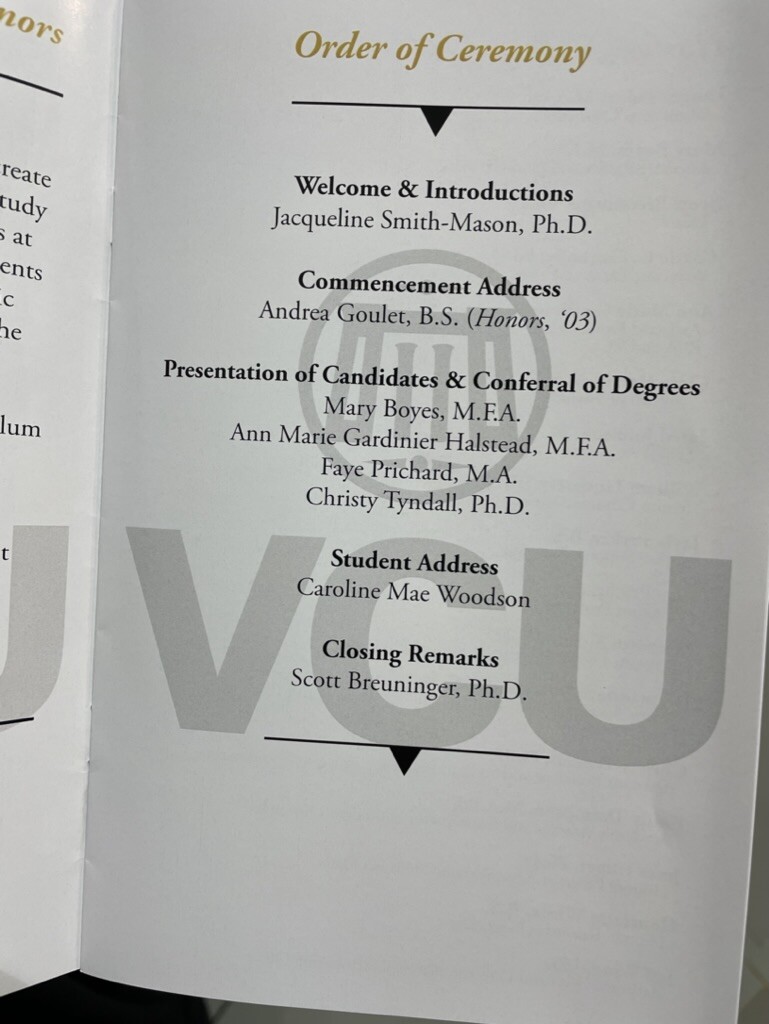
Last week, I had the distinct honor of delivering the commencement address for the 2022 VCU Honor’s College graduation, my alma mater.
As someone who gives talks all the time, I was surprised at the amount of emotional energy that went into developing this one. The ideas rumbled over in my brain for several weeks. I spent time with professors, administrators, and students to learn what their current challenges are, with COVID upending everything being the most prominent.
I also recalled my college experience. What advice would I give to the person I was then?
One idea was loud in my brain, crowding out all the others.
Perfectionism is an addiction — not an ideal.
After the ceremony, many people, particularly parents, told me how important this message was, especially for this year’s graduating class. I was asked if I could post a copy of the text so they could refer to it again. I’m so glad it resonated. This message was fighting to be shared.
Perfectionism, I’ve learned, isn’t just ineffective, it’s dangerous.
Perfectionism is brittle. It gives you strength but only to a point. Breaks are sudden, swift, and severe.
Perfectionism is static. It resists change, which makes it a poor strategy in a dynamic and complex environment.
Perfectionism is an illusion. It hides pain by making you feel a false sense of control.
Perfectionism is toxic. It triggers chemicals to course through your body that keep you hypervigilant and can shorten your life.
Perfectionism is draining. Never allowing yourself to take a break or make a mistake gives you less energy in the long run.
And finally, perfection isn’t valor. It’s fear that’s rooted in shame.
The ability to put our perfectionism away and open our hearts isn’t just fluffy feel-good stuff. It’s hard. It takes courage. And it can absolutely be worth it.
While this absolutely matters in our personal lives. It impacts our code, too. With my work, I’ve learned that the opposite of perfection isn’t failure — it’s resilience.
The seed of this idea was planted a decade ago after I’d read Brené Brown’s book Daring Greatly which linked perfectionism to addiction and shame. The whole book felt like a troubleshooting guide for my perfectionist lifestyle. I finally figured out WHY so many of my habits were ineffective and had landed me in abusive relationships, workaholic tendencies, depression, low self-worth, and worse. Perfectionism had been the root cause of so much of my pain — even though I’d thought it was one of my greatest assets.
Soon after, I watched an Oprah interview with Dr. Brown and a lightbulb went off.
“Shame needs three things to grow exponentially in our lives: secrecy, silence, and judgment,” Brown said. “If you put shame in a petri dish and douse it with a little secrecy, a little silence, and a little judgment, it grows exponentially. It will creep into every corner and crevice of your life.”
Yes. This was my experience personally. But wait…
Secrecy…silence…and judgment.
That described toxic tech culture. Plus, it sounded a lot like the anti-Agile “command and control” management style that everyone hated. Okay. That makes sense. The toxicity in tech is rooted in shame. So what do we do about it?
Brown went on. “If you put the same amount of shame in a petri dish and douse it with empathy, you’ve created an environment that is hostile to shame. Shame cannot survive being spoken. It cannot survive empathy.”
At that moment, here’s what became abundantly clear to me.
Shame, perfectionism, and “command and control” culture are all the same thing.
This means that empathy, as shame’s antidote, is what makes Agile possible.
At that moment, I decided to double down on empathy. I saw it as a tool not just for healing myself but as a way to help heal so many of the negative outcomes we see in the software industry. It’s how we transcend Agile from a set of dogmatic rituals that get rebooted every two weeks and actually get to what it’s really about— effective collaboration.
Scott and I made empathy a core part of our corporate culture at Corgibytes, long before it was cool. A consultant even warned me that if I used the words “empathy” and “software” in the same sentence, I should be prepared to be “laughed out of the industry.” We ignored this advice and I’m so glad we did.
My experience and research continue to tell me that investing in empathy on a software team is a virtuous cycle. Empathy, when applied effectively, is a key ingredient for resilient social and software systems. Work environments are calmer. People can be more proactive. Ideas are shared and respectfully challenged. The codebases become cleaner. Technical debt becomes less of a burden. Over time, thanks to intentionally applying empathy where it can be effective, I’ve noticed my perfectionism and micromanaging tendencies wane and the codebases we modernize become more stable, scaleable, and secure.
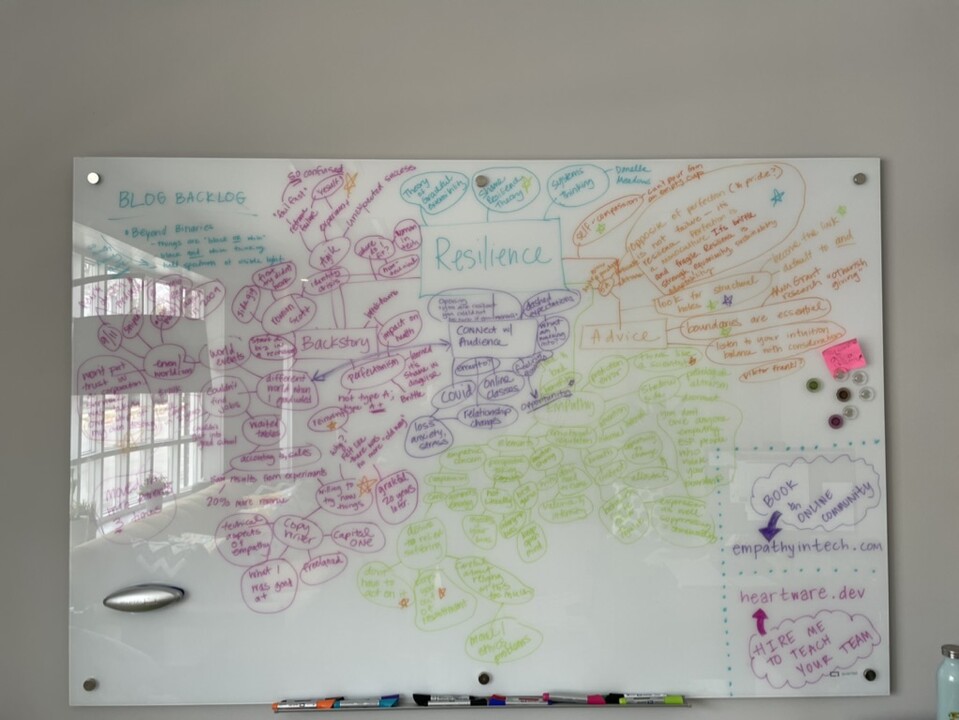
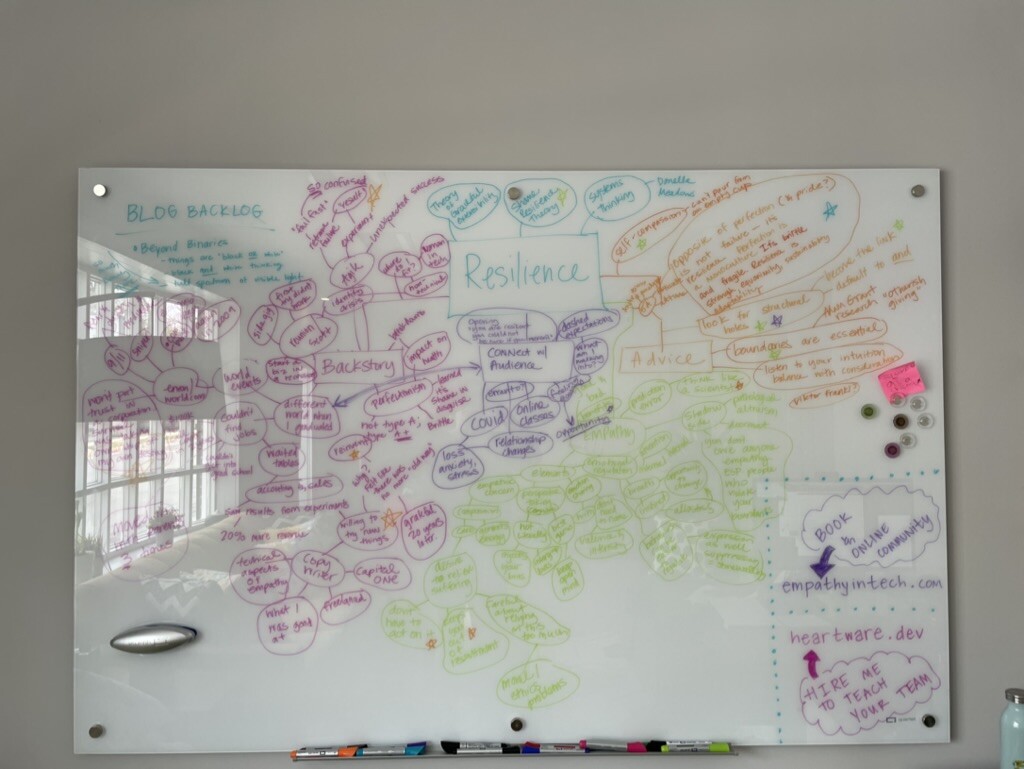
As I began to think about all the different things I could talk about for my commencement speech, one topic made so much more sense than anything else: it’s time to replace perfectionism with resilience. So I pulled out my whiteboard markers and got to work on the structure of the talk.
And with that backstory, here’s the final version of the speech. I hope it helps you, and your code, become a little more resilient.
______________________________________________________________
Hello.
My name is Andrea and I am a perfectionist.
Luckily, I bumbled into a career that focuses on how empathy impacts our software systems, which has caused me to swap out perfectionism in favor of resilience.
Perfectionism, like many addictions, is rooted in shame. It’s just shame that’s been dressed up to look presentable. Everyone feels shame. Shame the intense fear we feel when our sense of love or belonging is at risk. My high-school friend Scott, who later became my business and life partner told me this conversation we had in 11th grade stuck with him.
“Ok, Andrea. So what if you don’t get an A?”
“Well, then my GPA would slip and I won’t get into college, which means I won’t get a good job, which means I won’t make any money, which means I won’t have a good life and then I’ll be a complete failure and my Dad won’t love me.”
As soon as the words left my lips I tried to swallow them back. But it had been said. And it was true. I was terrified of losing my Dad’s love. That was shame. And I used perfectionism to cope.
And to be clear, my Dad has always loved me deeply. Losing his love wasn’t really a risk. But I valued his approval so much and had linked it to my own sense of self-worth, that any kind of criticism felt physically painful. Compared to rejection, the pain of pushing myself to be perfect felt good. Healing even. So I used perfectionism as a motivation tactic — kind of like how a jockey uses a crop to get their horse to run faster.
When I started my first business, I even used perfectionism as a selling point.
“You don’t have to worry,” I’d tell my clients. “You’re in good hands because I’m not just type-A. I’m type-A+!”
But, like many addictions, things began to spiral over time. By my 30’s perfectionism landed me in the behavioral health wing of St. Mary’s Hospital under close observation. I struggle with major depression and when I try to use perfectionism as a motivator now, it backfires. Always.
I’m healthier now and here are eight reasons why.
#1 — Develop the Skill of Self-Compassion
This is the most critical skill for those of us who are perfectionists. And yes, learning to be kind, nurturing, and caring towards yourself is most definitely a skill.
In the software world, there’s a practice called a retrospective where you reflect on what you’ve done and assess what went well, what could be better and what should change. Before the conversation starts, we ground ourselves in this truth.
“No matter what happened, everyone did the best they could at the time.”
This sentiment is critical because it keeps us out of shame and blame and helps us focus on collaboration. I’ve learned to keep this in mind when I make a personal mistake too.
#2 - Replace Shame Language with Guilt Language
Shame is “I am bad.” Guilt is “I did something bad.” This small tweak really matters.
Guilt is good because it holds us internally accountable when our behavior doesn’t match our values. Shame corrodes our confidence and sense of self-worth and leads to outcomes such as aggression, violence, bullying, depression, and a long list of other negative outcomes.
Here’s an example of how this works in real life. I used to say “Andrea, you’re such an idiot. Why did you [insert mistake here].” That was shame. Good intentions. Bad technique.
With guilt language, I trained myself to say something like: “Andrea that was a really stupid thing to do.” Notice that the emphasis is on the action — not me as a person. With even more practice, I’ve been able to layer on self-compassion, too. “Andrea, you messed up. You did your best under the circumstances, but let’s learn from this experience and choose differently next time.”
#3 — The Opposite of Perfectionism Isn’t Failure, It’s Resilience
We use resilience as a measurement of code quality in software. It’s what enables a system to adapt when change happens. And change always happens. Resilient software is healthy software.
You may not know it, but the challenges that you’ve faced have given you an extra degree that isn’t inscribed on your diploma. You have learned what it means to be resilient. You could have quit when things got hard and everything around you changed. But you didn’t. You weren’t perfect. You were resilient.
#4 — Learn to Love Fast and Honest Feedback
When Scott and I first started our business he would tell me we needed to “fail fast.” That made ZERO sense to me. I’d quip back that we didn’t want to fail at all. But what Scott was actually talking about was fast feedback loops. Learning what works and what doesn’t quickly gives us better data and we can make better decisions.
#5 — Healthy Boundaries are Critical
In software architecture, we have a concept called “bounded contexts.” I won’t bore you with the details but I’ve been amazed to learn how critical boundaries are in our personal lives as well.
Research tells us that the most successful people are generous and also know and communicate their limits. Unsuccessful people take this altruism to an unhealthy point where they actually can cause harm to themselves or others. Successful people give. Unsuccessful people give too much.
#6 — Expect Surprise.
There’s fascinating neuroscience research around what’s called the free energy principle. Our brains seek to minimize surprise as a means of conserving energy. And the best way to minimize surprise is to expect surprise. Never in a million years would I have thought I’d be finding joy geeking out over legacy code. Be open to surprise and you’ll be open to opportunities you never could have imagined.
#7 — Learn to Love Different Perspectives
Resilience requires diversity. It should be a big red flag if you find yourself in an experience where everyone is like you and no one is challenging you. That’s what perfectionism tricks you into thinking is safe, but resilience thinking will tell you is a monoculture and a risk.
And finally,
#8 — Learn What Makes Empathy Effective
Empathy is increasingly being hailed as the skill of the future. Its economic value is rising. Some researchers speculate that in the next fifteen years, empathy and communication skills will be more valuable than thinking and analytical skills as artificial intelligence becomes more powerful and prolific.
But empathy isn’t telepathy. It isn’t making assumptions about someone else’s experience. It’s definitely not being a doormat.
Empathy is about the balance between the hard-line and the soft heart.
I know the world feels uncertain, and fragile, and scary right now. I know it’s hard to keep up with the pace of change. But these are exactly the types of systems I’ve learned to wrangle using the skills I’ve just shared.
Empathy and resilience breed trust — and where there is trust, there is hope.
I know that many of you have experienced hardship and grief and pain that is visceral and intense. Whether that pain comes from perfectionism, personal loss, or from your college experience being turned upside-down and inside-out right as you were getting into your groove.
I don’t want to sweep that pain under the rug. I don’t want to cover it up in a veneer of platitudes. I want to let you know that I see you. That I believe in you. That you belong. You are loved. That every single one of us here today is immensely proud of you.
And we are honored beyond measure to welcome you into the VCU alumni community.
Congratulations, VCU Honor’s College Class of 2022!