How to Master the Hidden Patterns of Human Communication

Everything we’ve ever built that seemed impossible became possible the same way: someone got curious enough to find the patterns hidden in a system.
Take the James Webb Space Telescope, one of the most complex machines humans have ever built. With it, we can look at the light of the most distant stars and galaxies so we can understand how our universe was formed and investigate the potential for life in planetary systems.
Science is key to unlocking the hidden patterns in the universe. Isaac Newton, Albert Einstein, Edwin Hubble, and Annie Jump Cannon are just a few of the people who dedicated themselves to asking questions, testing hypotheses, observing carefully, and then asking more questions. When we follow the evidence, the patterns emerge.
Communication Has Its Own Pattern-Finders
While perhaps not as well known as the scientists who study physical systems, communication has its own scientific pattern-finders. One of the most influential is Claude Shannon.
In 1937, Shannon was a graduate student at MIT. He was thinking about digital circuits, the relay contacts and switches that were becoming central to emerging technological advances, such as telephone exchanges and industrial equipment. Building these circuit systems was cumbersome and time-consuming because there was no simple way to test it before you built it.
What if, Shannon pondered, you could develop an underlying logic to digital circuits? If you mapped out circuits using algebra and a system of symbols, then you could test them mathematically before you built them.
For his master’s thesis, “A Symbolic Analysis of Relay and Switching Circuits,” Shannon applied an algebraic system invented by the British mathematician George Boole to digital circuits. It used binary values (typically true and false) combined with operators such as AND, OR, and NOT as a way to notate formal logic. So if you’ve ever created a “Boolean,” you have Shannon to thank for it.
By the late 1940s, Shannon began working at Bell Labs where he was tasked with finding a way to make telephone signals clearer. It is through the lens of this problem that Shannon published his seminal work, “A Mathematical Theory of Communication,” which is illustrated in the following model:
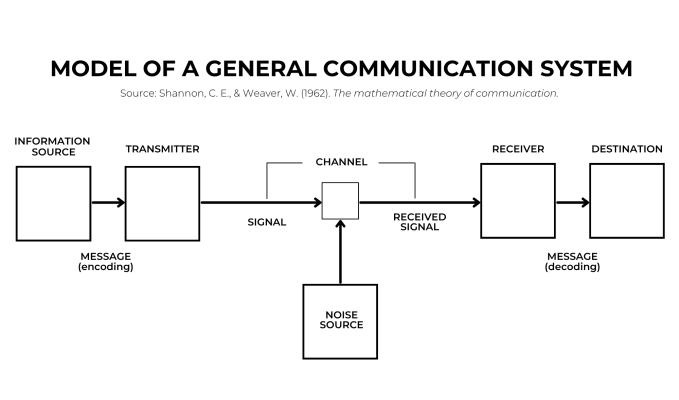
Information starts at a source, gets encoded so it can be sent by a transmitter, moves across a channel where it is impacted by noise, and then goes through a receiver that decodes it so it can arrive at its destination. He showed that information is measurable and developed mathematical models that became the foundation of the field of information theory.
It’s hard to overstate the impact Claude Shannon has had on our modern world. These two works form the basis of how computers are built, how software is created, and how the internet connects them. But what struck me the most when I was learning how to code was that I’d seen this model before in most of my marketing and communication courses in college. I decided to investigate and, to my surprise, it wasn’t just a similar model, it was the exact same model. The patterns that underpin our digital communication can be used to uncover the secrets of how humans communicate, too.
From Telephone Lines to Human Conversations
Shannon was focused solely on an engineering problem. His aim was to accurately transmit a message through an electro-mechanical system such as a computer or telephone exchange.
That’s where an influential science administrator named Warren Weaver comes in. He became fascinated with Shannon’s model and, shortly after Shannon’s paper was published, Weaver and Shannon co-authored a book that included the original paper along with Weaver’s commentary on its applications beyond electric signals. He theorized the patterns Shannon uncovered could “include all of the procedures by which one mind may affect another…not only written and oral speech, but also music, the pictorial arts, the theater, the ballet and in fact all human behavior.” This broader interpretation is how this model, which is often referred to as the Shannon-Weaver model, made its way into my communication classes.
Weaver outlined different classes of communication problems that together fully capture the nuances of human communication.
• Technical — How accurately can messages be transmitted?
• Semantic — How does transmission affect meaning?
• Effectiveness — How does the received meaning affect behavior?
Over the years, scientists have continued to explore the patterns of human language. Noam Chomsky launched the field of computational linguistics which revealed deep parallels between how computers and humans process language. John Gottman’s research modeled trust as a predictive system that aligns with the mathematical modeling in game theory more than it does intuition. Donella Meadows demonstrated the hidden patterns in complex systems that allow us to identify leverage points where a tiny change can have an outsized impact.
What Changes When You Treat Communication Scientifically
Over the past 15 years, I’ve been more than a little obsessed with creating a way to help people with deep technical expertise express their ideas clearly so they can communicate with more confidence and impact. Here are three things I’ve learned:
Communication is about predictions, not perfection.
Miscommunications are inevitable, but we can minimize them by treating our interactions as mini experiments that help us make better predictions.
Communication is about systems, not soft skills.
When something doesn’t land, a soft-skill mindset asks “what’s wrong with me?” — a systems mindset asks “where in the model did this break?”
Communication is about models, not magic.
Schematics based on science help us map out how information flows so we can build out mental models for the messages we send.